
Produced by: Christopher Russell - Public Affairs and Strategic Communications, Yimby LA Samuel Maury-Holmes - Founder, Zenith Economics
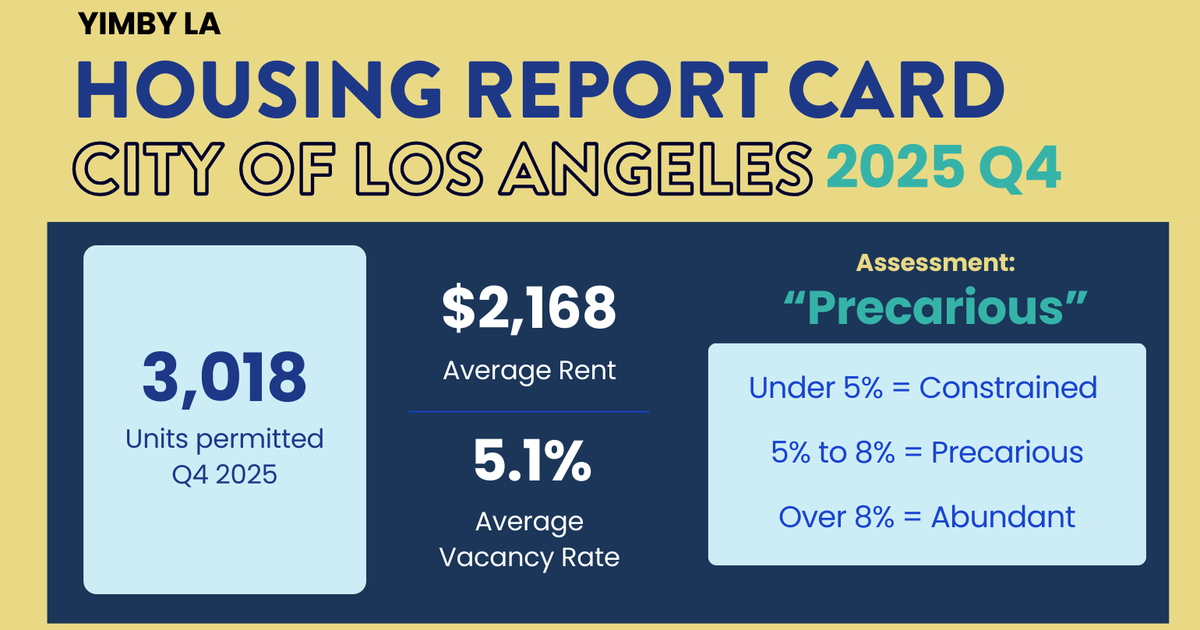
The final quarter of 2025 represented a pivotal moment for the Los Angeles housing market. While the LA City Council finalized some pro-housing regulatory reforms, like the Codification of ED1 and citywide expansion of the Adaptive Reuse Ordinance, the permitting of housing remained at a near-decade low. The City and State are generally building a legal framework for future density, but the City is still currently failing to meet its RHNA (Regional Housing Needs Assessment) production target of 456k total units for the 2021-2029 RHNA cycle.
Looking ahead, 2026 will be another opportunity to expand housing production in the City of Los Angeles. Over the past few years, efforts have been made by state and local policy makers (with SB-79 as a recent, prominent example) to expand housing production through the use of planning and zoning reforms. Now the City must address the uncompetitive cost of local construction (RAND) and local production hurdles like the lingering ULA gap (LAist) to ensure new ordinances and state laws translate into actual building permits, certificates of occupancy, and ultimately keys in hands.
Citywide Permitting Trends: Historically Weak Production
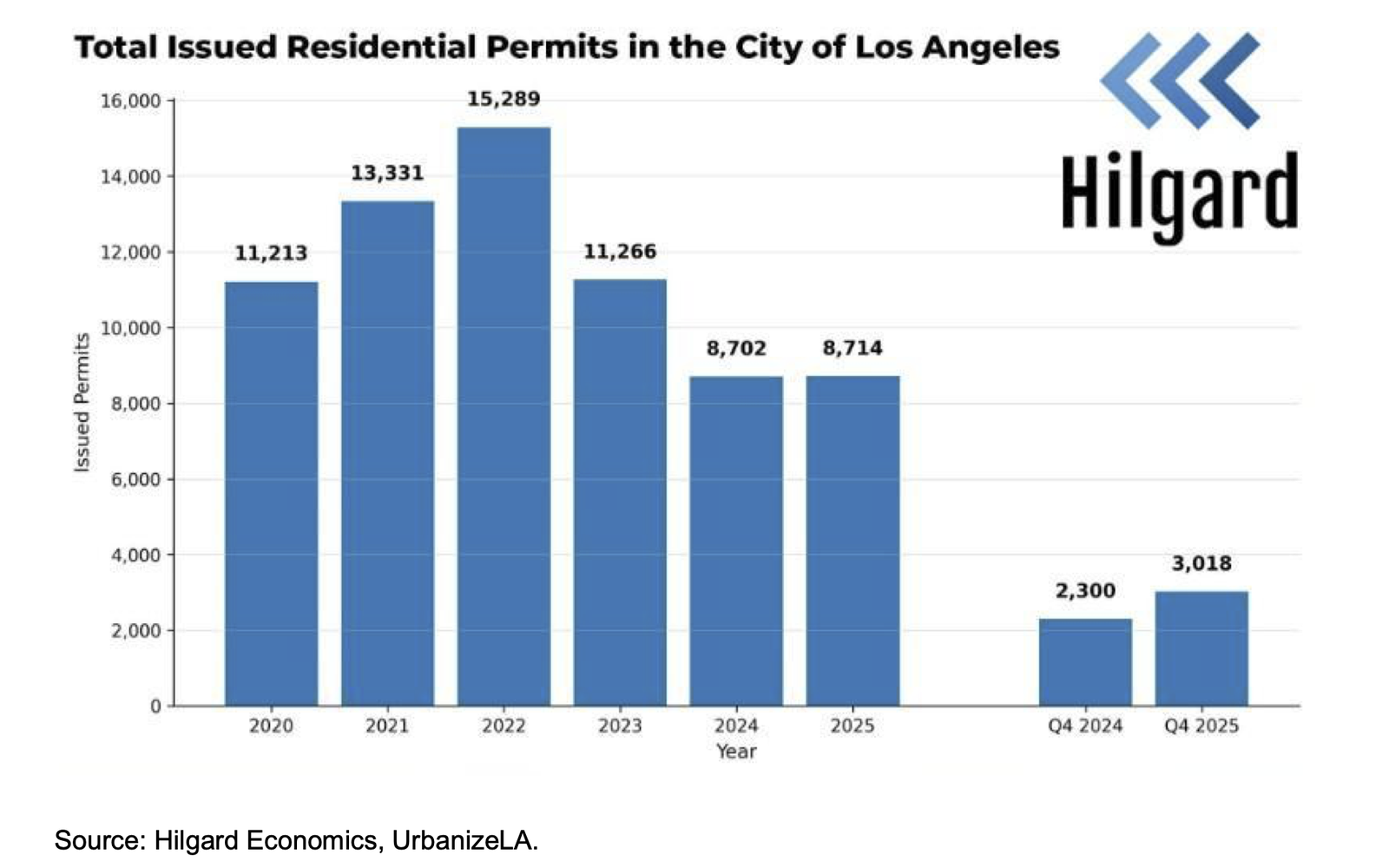
According to the January 2026 Hilgard Economics Report, residential permitting in Los Angeles for the full year of 2025 was "historically weak" with permit volume reaching 8,714 new residential units. The 2025 permitting volume is on par with the 8,702 units permitted in 2024, and it remains significantly below the annual average of 13,000 units seen between 2015 and 2022. The 8,714 units permitted in 2025 represent less than 16% of the 57,000+ units the city needs to permit annually to meet its state-mandated housing production goals.
Local Pro-Housing Policy Progress in Q4 2025
Despite the permitting lag, the City moved forward on several pro-housing legislative items in Q4-25:
- Adaptive Reuse Expansion: In December 2025, the City Council approved the citywide expansion of the Adaptive Reuse Ordinance. This allows developers across the City of Los Angeles to convert commercial buildings as recent as 15 years old into housing "by-right," removing the previous 1974 cutoff.
- ED1 Codification: The permanent version of Executive Directive 1 was finalized, ensuring that qualifying 100% affordable housing projects receive ministerial approval within 60 days. This removes the political uncertainty that previously surrounded the Mayor’s emergency order.
- LA Represented on the Calif. Coastal Commission (CCC): In October 2025, Governor Gavin Newsom appointed Los Angeles developer Jaime Lee to the California Coastal commission, suggesting a pro-housing shift that may impact portions of the City of Los Angeles subject to CCC rules like Venice Beach and Playa del Rey. Jaime Lee has contributed 6,600+ units to the region via Jamison Properties.
Regulatory Change: The RSO Formula Overhaul
In December 2025, the Los Angeles City Council approved the most significant change to the Rent Stabilization Ordinance (RSO) formula in over 40 years. This decision, aimed at providing long-term predictability for the city's 600,000+ rent-stabilized units, fundamentally alters the revenue landscape for multi-family housing.
Effective February 1, 2026, the annual allowable rent increase is set at 90% of the Consumer Price Index (CPI), down from the previous 100% of CPI calculation. The new formula establishes a 1% floor and a 4% ceiling on annual increases. Previously, the range was 3% to 8%. The Council also voted to eliminate the additional 1% increases previously allowed for landlords who pay for gas and electricity in master-metered buildings. While providing rent relief to long-term tenants that move infrequently, this policy shift has raised concerns regarding the long-term feasibility of maintaining aging housing stock as maintenance costs continue to outpace allowable rent growth. Additionally, the decision is a negative signal towards housing investment (including investment into new housing) in the City.
Fire Rebuild Trends: The Aftermath of the 2025 Wildfire Season
The 2025 Palisades and Eaton fires have placed unprecedented strain on the city’s rebuilding infrastructure. Data from the LAEDC 2025 Wildfire Study highlights the scale of destruction. The Palisades Fire alone destroyed 5,058 single-family homes and thousands of other residential properties were seriously damaged. Although the City implemented various strategies to streamline fire rebuilds, such as assembling a One-Stop Rebuilding Center, creating a rebuild resource website, and passing various streamlining laws like ED13, only a small fraction of destroyed units moved into the active construction phase by the end of Q4. Rebuilds generally face a substantial cost premium due to adherence to recent WUI (Wildland-Urban Interface) safety standards, often including ember-resistant materials and specialized ventilation.